
Not Minnesota Nice
Meditations on the Colonialism of Our Times
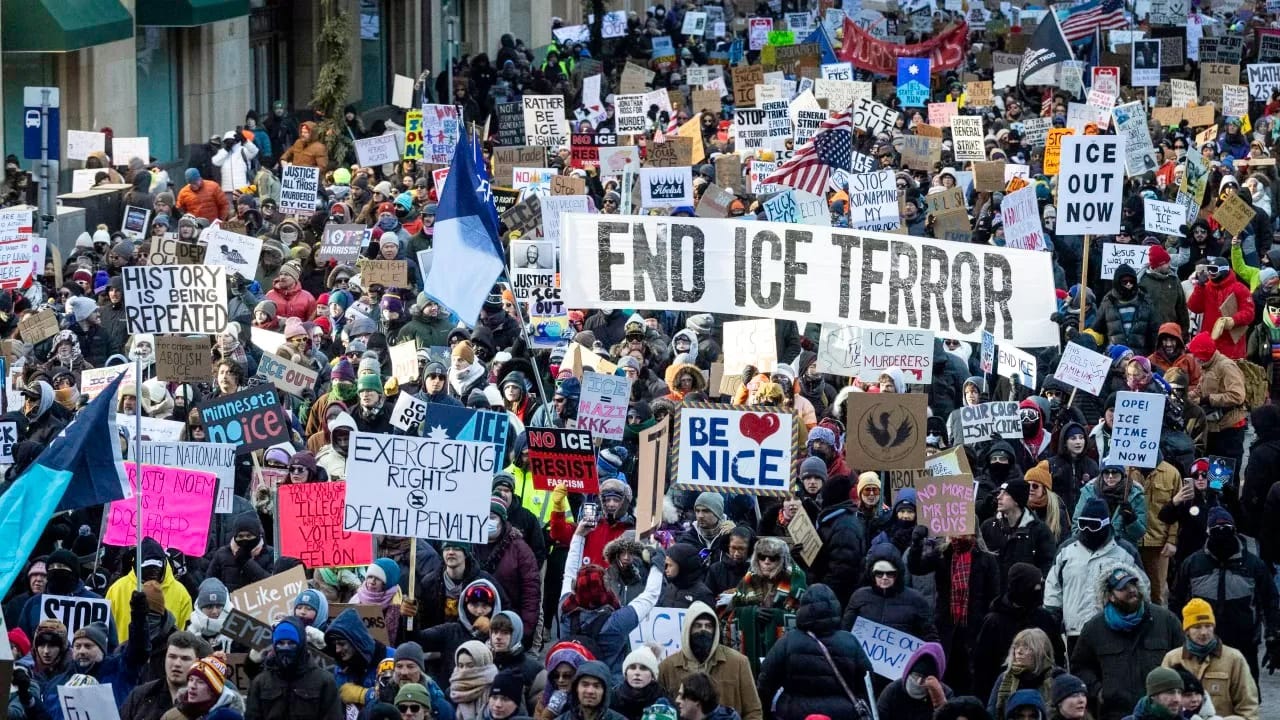
We are living through a moment of profound danger. Operation Metro Surge is barely two months old, and there is still no end in sight. Nowhere is safe. Not schools, daycares, parks, shopping centers, or hospitals.
What was presented as a crackdown on the “worst of the worst” has calcified into something far more perilous: an open-ended campaign of terror and political theater, carried out on the occupied streets of Minneapolis and increasingly across other parts of Minnesota. A permanent state of emergency has settled in. The presence of federal officers, who outnumber local police, is no longer exceptional but routine. Murder and abduction are treated as collateral. Terror itself appears to be the policy, not the byproduct.
Some call it fascism. Others call it something much worse. What matters more than the name is the recognition that this is not unprecedented. The truth is that this isn’t the first time we’ve been here, and perhaps it isn’t the worst time in the history of this land—a fact that offers no comfort to those living through the present nightmare. The present reality is untenable, as it must be, and everyday people are fighting back, as history suggests they always do. That’s why clarity is necessary. The country in which we now live is severely menaced, not by Putin, Xi, or the Ayatollah, but from within. And it has almost always been from within, despite America’s recurring insistence on locating its demons elsewhere.
The first enemy was, according to this country’s founding document, the “merciless Indian savages” in the hinterlands of its ever-expanding empire. By the time the nation’s leaders drafted the first constitution in 1787, the edge of that empire extended all the way to the confluence of the Mississippi and Minnesota rivers, a place Dakota people call Bdote and territory they called Mni Sota Makoce. The assertion of sovereignty preceded any real authority. In no way did those early Americans have any influence or control over the territory that they laid claim to. It was mostly a foreign, unknown land. The original name—Mni Sota Makoce, translated as “the land where the water reflects the sky”—incorporates the foundational relationship of its original caretakers with water, earth, and sky, and with the living beings, seen and unseen, who dwell among them. Early records show little interest on the part of Americans in understanding, let alone honoring, that relationship to place.
One might conjure the more recent phrase “land of ten thousand lakes” when trying to understand the meaning of Mni Sota Makoce. There are lots of lakes. But the phrase only gestures toward what the original name fully suggests. My understanding of this land is certainly changing and deepening the longer I live here. I also like to imagine the wintertime, Waniyetu, when thinking about this name and the relations it evokes. In winter, water covers the earth in the form of snow. And when it’s cold enough, airborne moisture crystallizes into ice, refracting the sun into prisms of color.Several mornings this winter have blessed me with the serenity of witnessing this effect in the form of sun dogs, the two rainbow-colored spots that flank the sun like sentinels when the conditions are just right. Indeed, a land where water reflects the sky is not bound by season. I can think of no place-name in English that evokes so much beauty and wonder.
The subtleties and nuances of that intimacy with the land, and the deep reciprocities and responsibilities it entails, were invisible to those who came to conquer it—and remain so for those who continue that relationship of conquest. The 1805 treaty with the Dakota, ceding land for what would later become Fort Snelling at Bdote, states clearly the intentions of the United States: establish a military presence and project force in the region. The treaty itself didn’t get full consent of Dakota people (just two leaders signed), nor did it meet the minimum legal criteria for validity. An 1856 Senate Military Affairs Committee found “no evidence” that it was ever a legally binding treaty.
The first presence of the United States came about through the construction of a military installation atop Bdote, a Dakota site of emergence and creation. The nation’s initial intentions were clear. Conquest requires a different set of relations and entails fundamentally different behaviors and practices. It requires destruction and replacement. Upon this foundation, the state erects its own superstructures of law, knowledge, and legitimacy. And it appears to understand its own unbelonging and tenuous control over the land. Otherwise, why would it need to exert so much force and fashion legal justifications and cultural narratives that originate from elsewhere? What kind of belonging demands such sustained violence against the land and its people?
From Fort Snelling, the United States sent soldiers to crush the Dakota uprising against colonial rule, imprison Dakota people in a concentration camp just below the fort, and expel them from their homelands. That function has not changed. The agents who abduct and terrorize my neighbors; attack daycare centers, schools, and hospitals; and who shot and killed Renee Good and Alex Pretti are performing the same functions and designs as the original Fort Snelling. They are headquartered at the same location, using the same name and intention: to intimidate, punish, and eliminate anyone who stands in the way.
To be continued.
Beautifully expressed. Thanks for keeping the light shining on the ICE invasion of Minneapolis and its impact on native as well as non-native working people. Your work is inspiring solidarity and resistance against the empire.